


The Story & Details
Violet crystal. Ancient Agate. A hidden eye within the stone.
Some mineral specimens are beautiful because of their colour. Others because of their formation. And then there are pieces where nature has brought together something so unusual that you find yourself looking twice.
This extraordinary Brazilian Amethyst Flower with Natural Agate Eye is one of those pieces.
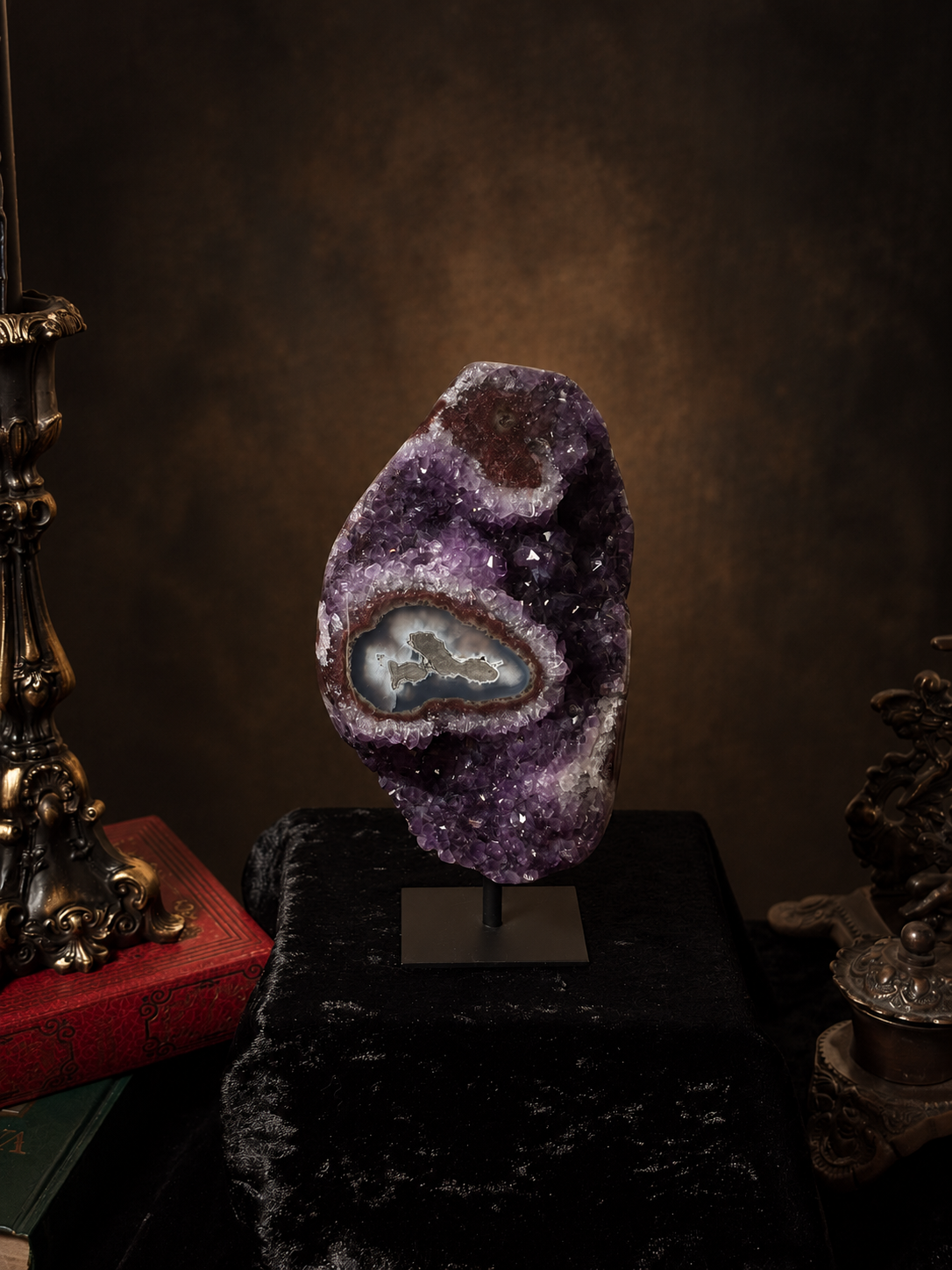
Weighing an impressive 1.313kg, this substantial natural specimen features a striking formation of deep violet Amethyst crystals surrounding a beautifully defined Agate centre.
The Amethyst displays rich variations of purple, from delicate lavender crystals around the edges to deeper, almost midnight-violet formations within its recessed crystalline areas.
But the feature that makes this specimen particularly captivating is the remarkable Agate formation nestled within the Amethyst.
Framed by a border of sparkling purple crystals, the polished Agate reveals concentric bands of smoky blue-grey, soft white and earthy reddish-brown surrounding an irregular natural centre.
It resembles an ancient eye, a miniature landscape or perhaps a window into another geological world.
The contrast is extraordinary.
Raw, angular Amethyst crystals surround the smooth, flowing patterns of the Agate, bringing together two very different expressions of Quartz within a single formation.
Mounted on a simple black display stand, the specimen appears almost suspended, allowing its unusual shape, crystalline texture and central Agate feature to become the focus.
Deep violet. Banded stone. A remarkable meeting of crystal and geological history.
Brazilian Amethyst: A World of Violet Crystals
Amethyst is the purple variety of Quartz, a mineral composed of silicon dioxide (SiO2).
Its distinctive violet colouring develops through geological processes involving trace iron within the crystal structure and natural irradiation.
Brazil is internationally recognised for its Amethyst deposits, particularly those associated with ancient volcanic formations.
Many Brazilian Amethyst specimens originate from cavities within volcanic rocks, where silica-rich fluids allowed Quartz crystals to grow over geological time.
As these fluids cooled and mineral conditions changed, crystalline layers and formations developed within the available spaces.
This specimen features densely packed Amethyst crystals with numerous individual terminations, creating a richly textured surface.
Its colour varies across the formation, with lighter lavender crystals transitioning into deeper purple areas.
The crystals reflect light at different angles, producing a beautiful natural sparkle without the need for artificial enhancement.
Unlike a completely polished specimen, this Amethyst retains much of its natural crystalline character.
The Agate Eye: A Formation Within a Formation
At the centre of this specimen sits an especially fascinating geological feature.
A natural Agate formation is surrounded by a border of Amethyst crystals, creating a striking contrast between smooth banding and raw crystalline growth.
Agate is a variety of Chalcedony, a fine-grained form of silica commonly associated with layered mineral deposition.
Its characteristic bands develop as silica-rich fluids deposit material within cavities over successive periods of mineral growth.
Changes in mineral chemistry, trace elements and growth conditions can create variations in colour, opacity and texture.
In this specimen, the Agate displays beautiful blue-grey and white bands, with reddish-brown bordering and an irregular central mineral pattern.
The central feature resembles an eye, although its appearance is entirely the result of natural geological formation.
Surrounding the Agate, tiny Amethyst crystals create a sparkling violet frame.
This relationship between the smooth Agate and the surrounding crystalline Amethyst makes the specimen especially appealing.
It offers two distinct mineral textures within one remarkable display piece.
Amethyst Flowers: Natural Sculptures of the Earth
The term Amethyst Flower is commonly used within the mineral trade to describe certain naturally occurring Amethyst formations with decorative, flower-like or radiating crystalline structures.
These specimens are appreciated for their irregular shapes, complex crystal growth and sculptural appearance.
Unlike a conventional geode with a simple rounded cavity, an Amethyst Flower may display unusual outlines, projecting crystalline areas and contrasting mineral features.
This particular specimen has an asymmetric, upright form, with exposed Amethyst crystals creating a textured violet surface around the central Agate.
The darker recessed areas add depth, while lighter crystal edges highlight the natural contours of the formation.
The exposed mineral structure near the upper section provides another fascinating detail, revealing variations in the underlying geological material.
Viewed from different angles, the relationship between the Amethyst crystals and the Agate centre changes, making this a specimen that invites exploration.
A Statement Specimen for the Unusual Collector
At approximately 1.313kg, this is a substantial mineral display piece.
Its combination of deep violet Amethyst, naturally banded Agate and irregular crystalline structure creates an appearance that is both dramatic and refined.
The included black display stand elevates the specimen, allowing light to reach the crystal surfaces and emphasising its distinctive shape.
It would make a striking addition to a dedicated mineral cabinet, gothic-inspired interior, personal altar, curiosity collection or carefully arranged display.
For collectors drawn to unusual mineral associations, natural Agate formations or specimens with strong visual character, this piece offers something particularly memorable.
Rather than relying on size alone, its beauty lies in the extraordinary details that nature has brought together.
Traditional Associations
Within contemporary crystal and spiritual traditions, Amethyst is commonly associated with:
- Intuition & Psychic Work: Symbolically associated with inner awareness, spiritual reflection and intuitive exploration.
- Spiritual Growth: Representing wisdom, personal development and a deeper connection with spiritual practices.
- Protection & Warding: Traditionally associated with maintaining peaceful spaces and symbolic energetic boundaries.
- Peace & Calm: Representing tranquillity, emotional balance and thoughtful reflection.
- Clarity: Encouraging contemplation, perspective and a clearer understanding of personal intentions.
- Meditation: Frequently incorporated into spiritual practices focused on stillness and awareness.
Agate carries its own traditional associations:
- Grounding: Symbolising stability, connection with the Earth and a sense of balance.
- Protection: Historically used in decorative objects and amulets associated with safeguarding the wearer or their surroundings.
- Harmony: Representing balance between different aspects of life.
- Inner Strength: Associated with patience, resilience and steady personal development.
The eye-like appearance of the central Agate may also appeal to those interested in symbolism surrounding awareness, perception and hidden knowledge.
Combined, the Amethyst and Agate can symbolise grounded intuition, spiritual awareness and the balance between inner wisdom and earthly stability.
These associations reflect spiritual beliefs and cultural traditions rather than scientifically established therapeutic effects.
Product Details
- Primary Material: Natural Amethyst
- Associated Mineral: Agate (Chalcedony)
- Weight: Approximately 1.313kg (1,313g)
- Origin: Brazil
- Form: Natural Amethyst Flower / Crystal Cluster
- Colour: Deep violet, lavender, smoky blue-grey, white and reddish-brown
- Crystal Features: Dense Amethyst crystal points, recessed crystalline areas and natural mineral matrix
- Agate Features: Distinctive banded Agate eye with polished exposed surface
- Display: Mounted on black metal display stand
- Availability: One of a kind
- Photographs: Exact piece shown
Display & Care
Amethyst and Agate are both silica-based minerals, with Quartz measuring approximately 7 on the Mohs hardness scale.
Although relatively durable, exposed crystal points and natural edges may chip or fracture if knocked.
Handle this specimen carefully, supporting the main mineral body rather than lifting it by individual crystal projections.
Display on a stable, level surface with the stand positioned securely.
Avoid prolonged direct sunlight, which can cause fading in some Amethyst specimens.
Dust gently using a soft, dry brush, taking particular care around the densely packed crystal points.
Avoid harsh chemicals, abrasive cleaning products, ultrasonic cleaners and sudden temperature changes.
Please Note
- You will receive the exact Brazilian Amethyst Flower specimen shown in the photographs.
- Natural mineral specimens may contain inclusions, fractures, irregular crystal growth, matrix deposits and incomplete crystal terminations.
- The central Agate formation is a natural geological feature and may display variations in polish and surface texture.
- Colours may appear different depending on lighting conditions, viewing angle and screen settings.
- Weight is approximate.
- The black display stand shown is included.
- Exact mine locality has not been confirmed.
- Metaphysical information is provided for spiritual and cultural interest only and is not intended as medical advice.
A hidden eye surrounded by violet crystal. A beautiful reminder that the Earth creates its own extraordinary works of art.
Crystal Asylum - Hand-selected for those who appreciate the unusual, the powerful and the extraordinary.