

The Story & Details
Death. Rebirth. Transformation. A serpent guarding the mysteries of existence.
Some crystal carvings are designed simply to be beautiful. Others tell a story through their symbolism.
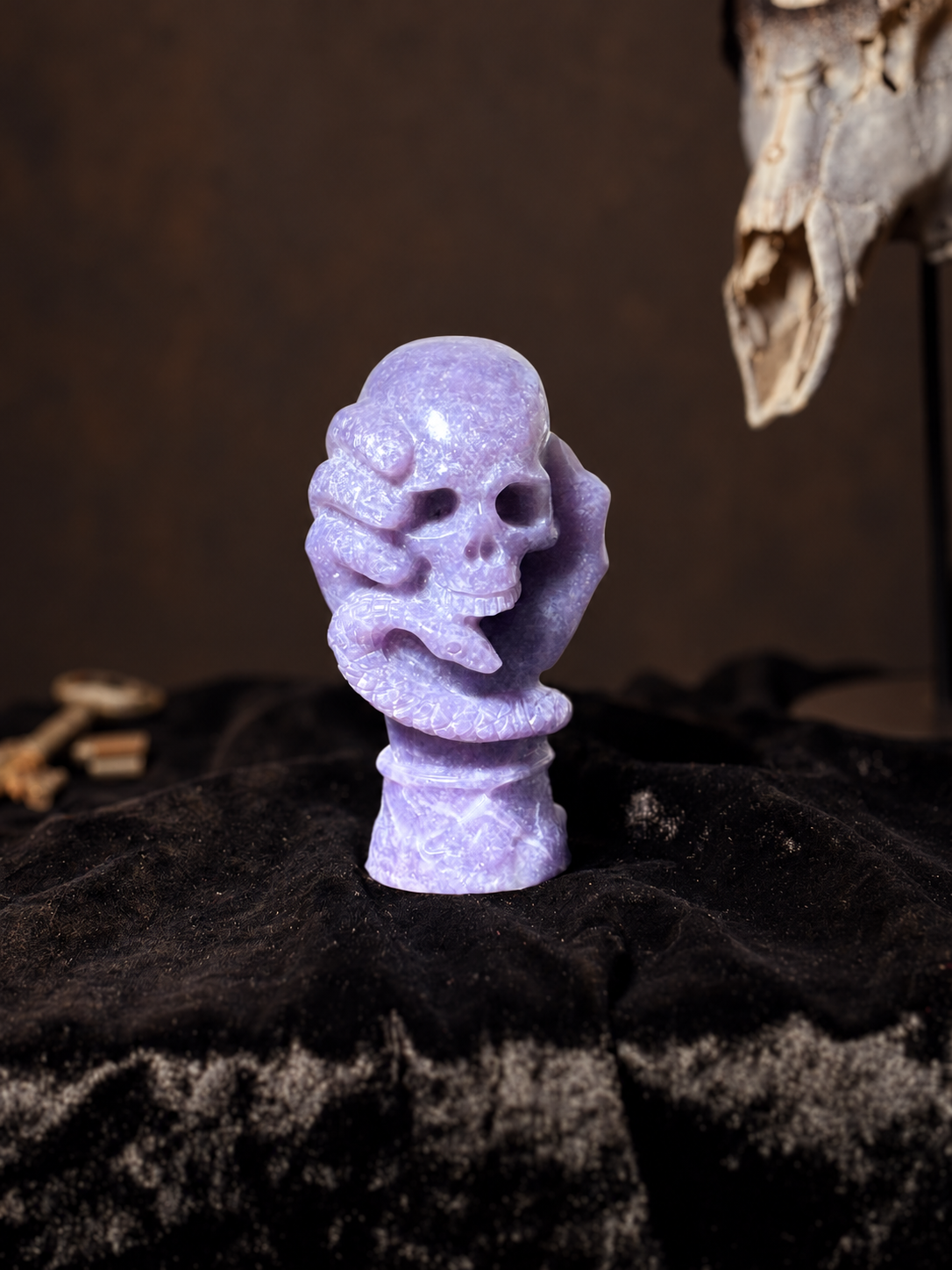
This extraordinary Lepidolite Skull with Serpent and Hand Carving brings together three powerful motifs: the human skull, the serpent and the protective grasp of a hand.
Carved from beautiful lavender-purple Lepidolite, the sculpture features a human hand wrapped around a skull, while a textured serpent coils beneath it.
The skull sits within the hand's grasp, its hollow eye sockets, defined cheekbones and carefully carved teeth creating a striking contrast against the rounded fingers surrounding it.
The serpent winds across the lower portion of the carving, its scaled body adding movement and texture to the composition.
Throughout the stone, soft lilac, lavender and deeper violet tones mingle with delicate silvery reflections and natural mineral variations.
These subtle variations give the polished carving an almost ethereal appearance, particularly where the light catches its gently shimmering surface.
The entire sculpture rests upon an integrated carved pedestal, allowing it to stand upright as a miniature symbolic monument.
There is something particularly captivating about the relationship between the three elements.
The hand appears to hold mortality itself. The skull represents the inevitability of change. The serpent, traditionally associated with renewal and transformation, coils beneath them both.
Three ancient symbols. One beautifully unusual carving.
Lepidolite: The Lavender Mica
Lepidolite is a lithium-bearing mica mineral belonging to the mica group.
Its distinctive lavender, pinkish-purple and lilac colouring is commonly associated with manganese within its mineral composition.
As a mica, Lepidolite has a layered crystal structure, with thin sheets that can produce a delicate pearly or silvery lustre.
When polished, this characteristic can create subtle shimmering reflections across the stone.
This carving displays beautiful variations of lavender-purple, with lighter silvery areas and deeper violet tones visible throughout the sculpted surfaces.
The polished finish highlights the stone's natural colour while allowing the intricately carved details to remain clearly defined.
Although Lepidolite can occur in several geological environments, it is particularly associated with lithium-rich granitic pegmatites.
Its relatively soft and layered mineral structure makes detailed carving and careful handling especially important.
The mineral identification is based on the supplied description and has not been independently laboratory verified.
The Skull: Mortality, Wisdom & Transformation
The human skull has appeared throughout art, philosophy, mythology and spiritual traditions for centuries.
Although often associated with death, its symbolism extends far beyond mortality.
In European art, skulls became prominent within the tradition of memento mori, a Latin expression meaning "remember that you must die".
Rather than simply representing death, these objects encouraged reflection upon the temporary nature of life and the importance of living with intention.
Skulls have also been used symbolically to represent ancestral memory, wisdom, transformation and the relationship between endings and new beginnings.
Within contemporary spiritual practices, skull carvings are sometimes incorporated into meditation, ancestor work and personal reflection.
In this sculpture, the skull is not presented alone.
It is held within the grasp of a carefully carved hand, creating a powerful visual relationship between human existence and the passage of time.
The Serpent: An Ancient Symbol of Renewal
Few creatures have carried as many symbolic meanings throughout human history as the serpent.
Appearing in ancient Egyptian, Greek, Mesopotamian and numerous other cultural traditions, serpents have been associated with wisdom, protection, danger, transformation and the mysteries of life and death.
One of their most enduring associations is renewal.
Because snakes periodically shed their skin, they became powerful symbols of regeneration, change and the ability to move beyond an earlier state of existence.
In Greek mythology, serpents appear in connection with deities, sacred places and the transmission of hidden knowledge.
They also feature in the symbolism of Hekate, particularly within later magical and esoteric traditions, where serpents may be associated with liminal spaces, transformation and chthonic mysteries.
Within modern witchcraft, the serpent is frequently interpreted as a symbol of personal power, intuition, rebirth and the cyclical nature of existence.
Here, the serpent coils beneath the skull, creating an intriguing contrast between mortality and renewal.
Its textured scales and curved form introduce movement into an otherwise contemplative sculpture.
The Hand: Holding the Passage Between Worlds
The hand is one of the oldest and most recognisable symbols in human art.
Depending upon its cultural context, an open or grasping hand can represent protection, control, connection, creation or the act of holding something precious.
In this carving, the fingers curl around the skull, framing its features and drawing attention towards the face.
The composition can be interpreted in several ways.
It may represent humanity's relationship with mortality, the protection of ancestral wisdom or the conscious acceptance of change.
Combined with the serpent, the sculpture creates a visual narrative of endings, renewal and the forces that connect them.
These interpretations are symbolic rather than claims about the original intention of the carver.
A Carving for the Unconventional Collector
This is not a conventional crystal ornament.
Its detailed anatomical imagery, coiled serpent and beautiful lavender colouring create a distinctive combination of gothic aesthetics and spiritual symbolism.
The polished Lepidolite contrasts with the textured scales of the serpent, the smooth contours of the skull and the sculpted fingers surrounding it.
The integrated pedestal allows the carving to stand independently, making it particularly suited to a collector's cabinet, gothic-inspired interior, personal altar or display of unusual mineral sculptures.
It may appeal especially to collectors interested in memento mori artwork, serpent symbolism, mythology, witchcraft or pieces exploring the relationship between life and death.
Traditional Associations
Within contemporary crystal and spiritual traditions, Lepidolite is commonly associated with:
- Peace & Calm: Symbolising tranquillity, reflection and emotional steadiness.
- Transformation: Representing personal change, growth and the acceptance of new beginnings.
- Intuition & Psychic Work: Associated with contemplation, inner awareness and spiritual exploration.
- Spiritual Growth: Symbolising the development of wisdom and deeper self-understanding.
- Shadow Work: Used symbolically within practices exploring hidden aspects of the self.
The sculpture's imagery introduces additional traditional associations:
- Skull: Mortality, ancestral wisdom, remembrance and transformation.
- Serpent: Renewal, rebirth, hidden knowledge and personal power.
- Hand: Protection, connection, intention and guardianship.
Together, these elements create a powerful symbolic representation of mortality, renewal, inner wisdom and the courage to embrace transformation.
These associations are based on cultural symbolism and spiritual beliefs rather than scientifically established therapeutic effects.
Product Details
- Material: Lepidolite (supplier identification)
- Form: Hand-carved skull, serpent and hand sculpture
- Colour: Lavender, lilac, violet and silvery-purple
- Finish: Polished with textured carved details
- Design: Human hand holding a skull with coiled serpent
- Base: Integrated carved pedestal
- Origin: Not confirmed
- Availability: One of a kind
- Photographs: Exact piece shown
Display & Care
Lepidolite is a relatively soft mineral, generally measuring approximately 2.5 to 4 on the Mohs hardness scale, depending on its composition and mineral associations.
Its layered mica structure means it should be handled with care to avoid scratching, chipping or damage.
Display the carving on a stable, level surface away from areas where it may be knocked.
Avoid lifting the sculpture by individual fingers, the serpent or other projecting details.
Clean gently using a soft, dry cloth or brush.
Avoid prolonged contact with water, harsh cleaning chemicals, abrasive products and sudden temperature changes.
Please Note
- You will receive the exact Lepidolite carving shown in the photograph.
- Natural stone may contain inclusions, colour variations, internal fractures and mineral irregularities.
- Hand-carved details may show small variations in texture and polish.
- Colours may vary depending on lighting conditions and screen settings.
- Exact mineral composition and country of origin have not been independently verified.
- Metaphysical information is provided for spiritual and cultural interest only and is not intended as medical advice.
A skull held in the hand of fate. A serpent beneath it. A reminder that every ending carries the possibility of transformation.
Crystal Asylum - Hand-selected for those who appreciate the unusual, the powerful and the extraordinary.