


The Story & Details
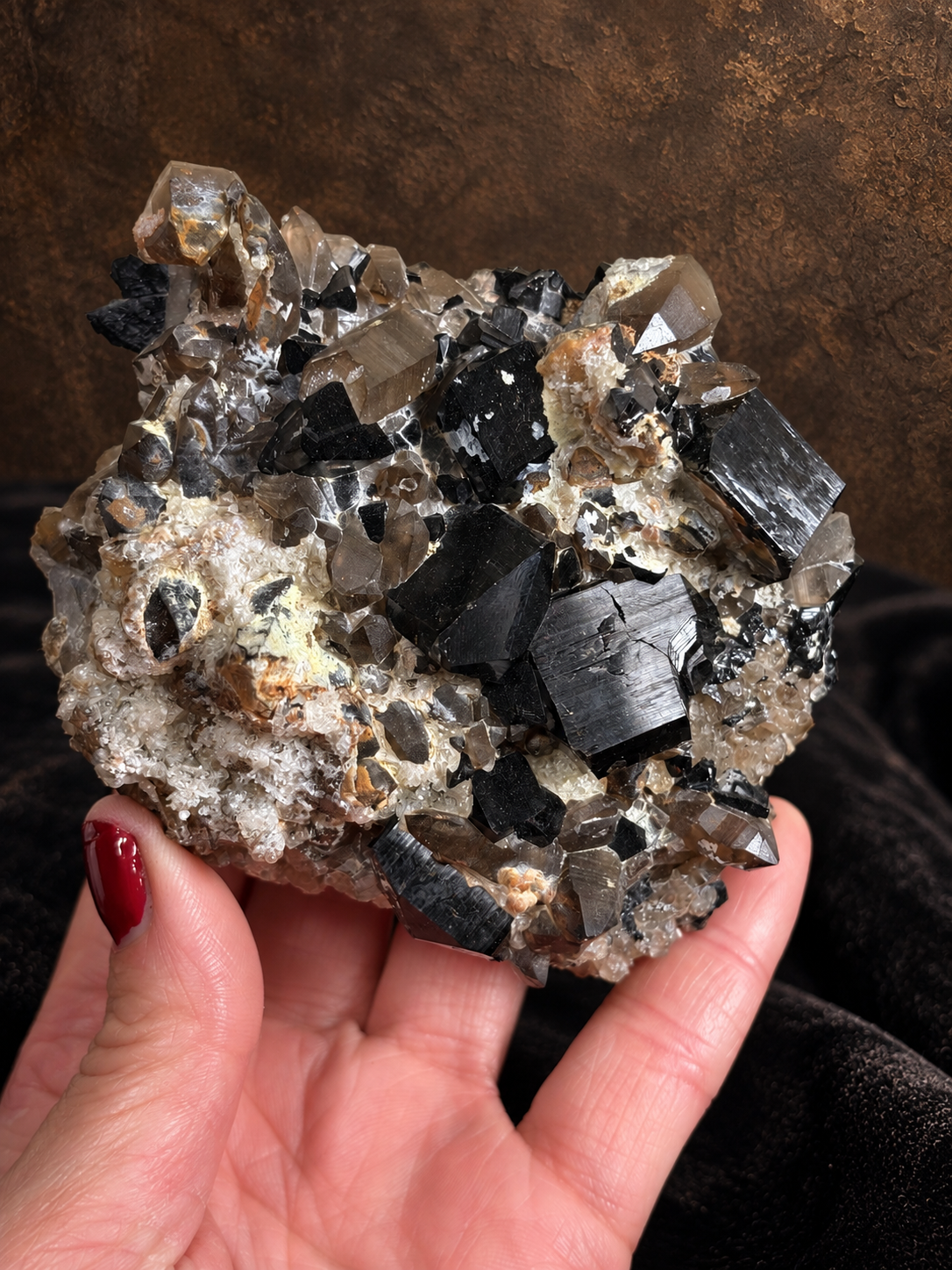
By daylight, a remarkable Namibian mineral specimen. Under ultraviolet light, something entirely unexpected.
Some specimens are collected for their crystal formations. Others for their locality, rarity or unusual mineral associations.
This extraordinary Namibian Black Tourmaline & Smoky Quartz Specimen brings together several of those qualities in one striking natural formation.
Originating from the Karib District, Erongo Region, Namibia, this substantial collector piece displays a dramatic arrangement of dark Black Tourmaline crystals amongst translucent Smoky Quartz and contrasting pale matrix material.
The crystal formations create an intricate, almost architectural landscape. Deep black, sharply defined faces rise above smaller smoky crystals, while the surrounding mineral matrix introduces variations in texture, transparency and colour.
Look closely and the detail becomes even more interesting.
Individual crystal faces catch the light differently, revealing subtle reflections across the darker formations. Smaller points and natural growth features fill the spaces between the larger crystals, giving the specimen remarkable depth from multiple viewing angles.
But its most unexpected feature only becomes visible under ultraviolet light.
A Hidden Fluorescent Display
When illuminated with suitable UV light, areas of the specimen's matrix display a striking electric-green fluorescence.
The effect creates a dramatic contrast against the dark Tourmaline and Smoky Quartz, transforming the appearance of the specimen without altering its natural structure.
Fluorescence occurs when certain materials absorb ultraviolet radiation and emit visible light. The precise response depends on the mineral composition, trace elements and characteristics of the UV source.
In this specimen, the green fluorescence is particularly striking because it appears amongst the darker crystals, creating an unusual combination of natural crystal growth and optical behaviour.
The exact fluorescent mineral has not been independently identified, so the green response is attributed to areas of the matrix rather than to a specific mineral species.
From the Erongo Region of Namibia
The Erongo Region of Namibia is internationally recognised amongst mineral collectors for producing a remarkable variety of well-formed crystals and unusual mineral associations.
Its granitic pegmatites and associated geological environments have yielded notable specimens of Tourmaline, Quartz and numerous other collector minerals.
This particular piece comes with an especially interesting provenance detail.
According to the supplier, the specimen was personally mined by him in the Karib District of the Erongo Region.
That direct connection to its source adds another dimension to the piece, offering collectors more than an attractive mineral arrangement.
It is a specimen with a stated locality and a personal extraction history, both valuable details when documenting a mineral collection.
The Mineral Association
Black Tourmaline, commonly known as Schorl, is a member of the Tourmaline group recognised for its dark colouring, elongated crystal habits and distinctive striations.
Smoky Quartz is a naturally coloured variety of crystalline quartz, admired for its translucent grey-to-brown tones and well-formed crystal terminations.
Together, these minerals can create particularly striking collector specimens, with the darker Tourmaline providing contrast against the translucent Quartz.
In this piece, the additional fluorescent matrix introduces a further element of mineralogical interest.
Traditional Associations
Within contemporary crystal traditions, Black Tourmaline and Smoky Quartz are often symbolically associated with:
- Protection & Warding: Traditional protective practices and personal boundaries.
- Grounding: Stability and connection to the present moment.
- Courage & Strength: Resilience and personal determination.
- Transformation: Reflection and navigating periods of change.
These are traditional spiritual associations rather than scientifically established effects.
Product Details
- Primary minerals: Black Tourmaline and Smoky Quartz, as supplied
- Tourmaline variety: Presumed Schorl
- Additional material: Natural mineral matrix
- Optical feature: Electric-green UV fluorescence in areas of the matrix
- Locality: Karib District, Erongo Region, Namibia
- Provenance: Personally mined by the supplier, according to supplier information
- Colour: Black, smoky brown, grey and pale mineral matrix
- Formation: Natural crystal cluster on matrix
- Weight: Approximately 500–600g
- Finish: Natural, unpolished specimen
- Availability: One of a kind
- Photographs: Exact specimen shown
Display & Care
Display on a stable, level surface capable of supporting the specimen's weight.
Natural crystal terminations, exposed edges and smaller growth features may be fragile. Handle carefully and avoid placing pressure on individual crystals.
Clean gently with a soft, dry brush where necessary. Avoid soaking, harsh cleaning chemicals and abrasive methods, particularly because the full composition of the matrix has not been established.
To observe the fluorescence, use a suitable UV light source and follow the manufacturer's safety instructions. Never look directly into a UV lamp or shine it towards the eyes or skin.
Please note: The intensity and appearance of fluorescence will vary depending on UV wavelength, lamp strength, surrounding lighting and viewing conditions.
Natural contact points, fractures, inclusions, growth features and minor edge wear may be present and should be assessed from the individual specimen photographs.
Chosen for Presence at Crystal Asylum. An extraordinary Namibian locality specimen, selected for its crystal formations, fluorescence and geological character.