


The Story & Details
Iron-red crystals. Sugary formations. A remarkable piece of the earth's architecture.
Some mineral specimens are beautiful because of their colour. Others because of their crystal formations. This extraordinary Red Dogtooth Calcite specimen manages both.
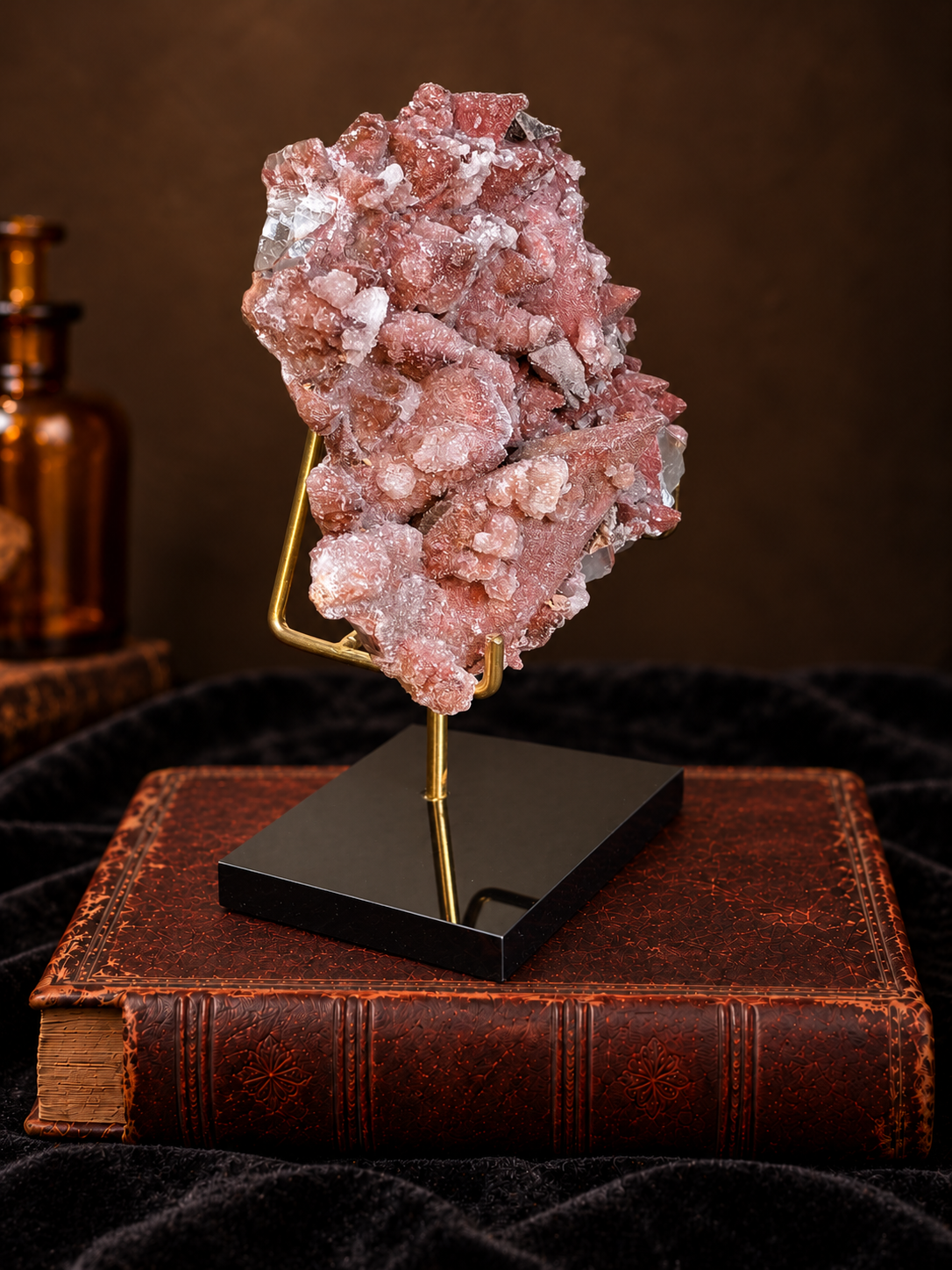
Originating from the Qinglong Mine in Guizhou Province, China, this substantial crystal cluster weighs approximately 1.139kg and brings together dramatic red Dogtooth Calcite formations with contrasting pale mineral growth supplied as Selenite.
The first thing that catches your attention is the colour. Warm, dusty red and earthy rose tones cover a densely packed landscape of angular crystals, irregular formations and sparkling crystalline surfaces.
Look closer and the structure becomes even more interesting.
Sharp, pointed Dogtooth Calcite crystals emerge at different angles, creating a layered formation that looks almost architectural. Across their surfaces, fine sparkling crystals produce a beautiful sugar-like texture.
Scattered throughout the formation are contrasting pale white and translucent mineral areas, adding another dimension to an already complex specimen.
There is nothing particularly delicate or uniform about this piece. It is rugged, densely crystallised and full of unexpected detail.
Displayed on its gold-toned metal stand with a dark square base, the cluster becomes a striking sculptural specimen.
Raw geometry. Earth-red colour. Thousands of tiny crystalline reflections.
Red Dogtooth Calcite: A Remarkable Crystal Formation
Calcite is a calcium carbonate mineral with the chemical formula CaCO3.
It is one of the most widespread carbonate minerals on Earth and occurs in an extraordinary variety of crystal habits, colours and geological environments.
Dogtooth Calcite refers to a distinctive crystal habit characterised by elongated, pointed scalenohedral crystals.
These formations are sometimes described as resembling canine teeth, giving rise to the familiar name Dogtooth Calcite.
Unlike the familiar blocky rhombohedral forms of Calcite, scalenohedral crystals can create dramatic clusters of sharp-looking points and intersecting geometric structures.
This specimen features numerous angular crystals growing together in a dense, irregular arrangement.
The red and pinkish colouring may be associated with iron-bearing mineral impurities or surface coatings, although the precise colouring agent has not been independently established for this specimen.
The result is a particularly striking combination of geometric structure, warm earthy colour and sparkling mineral texture.
A Sugary Crystal Surface
One of the most distinctive features of this specimen is its densely sparkling surface.
Many of the larger red crystal faces are covered with much smaller crystalline growths, creating a fine, granular appearance often described by collectors as sugary or sugar-coated.
These tiny crystals catch the light from numerous directions, giving the specimen a soft, almost frosted sparkle.
The contrast is particularly beautiful because the larger Dogtooth formations remain clearly visible beneath the delicate crystalline coating.
Rather than a simple cluster of individual points, the specimen displays multiple generations or styles of mineral growth across its surface.
Some areas appear densely encrusted, while others reveal more defined geometric faces and pointed terminations.
It is the kind of specimen that rewards close inspection, with different textures becoming apparent as the viewing angle changes.
Selenite and Contrasting Mineral Growth
Among the red Calcite formations are pale, whitish and translucent mineral areas supplied as Selenite.
Selenite is a crystalline variety of Gypsum, a hydrated calcium sulphate mineral with the formula CaSO4·2H2O.
Gypsum can develop alongside other minerals in suitable geological environments, creating contrasting textures and crystal habits within a single specimen.
The pale formations provide a beautiful visual contrast against the red Calcite, breaking up the warm colouring with lighter crystalline details.
The precise identity of the associated pale minerals has not been independently verified, so Selenite is used here according to the supplied specimen identification.
Qinglong Mine, Guizhou Province, China
This specimen is attributed to the Qinglong Mine in Guizhou Province, China.
Guizhou is a mineral-rich region of southwestern China, known for its complex geology and a variety of mineral deposits.
The Qinglong mining district is associated with significant hydrothermal mineralisation and has produced specimens of interest to mineral collectors.
The locality adds geological context to this unusual combination of red Calcite formations, fine crystalline coatings and contrasting associated minerals.
For collectors who appreciate specimens with a named locality, distinctive crystal habits and natural mineral associations, this is a particularly interesting display piece.
A Substantial Collector's Specimen
At approximately 1.139kg, this is a substantial mineral specimen with considerable visual presence.
The exposed crystal cluster is irregular rather than symmetrical, with projecting points, densely crystallised areas and contrasting pale mineral deposits.
Viewed from the front, the red crystalline surfaces form a dramatic landscape of intersecting points and sugary textures.
From the side, the depth of the formation becomes more apparent, revealing overlapping crystals and projecting mineral growth.
The supplied gold-toned display stand elevates the specimen above its dark square base, allowing the complex formation to be appreciated as a sculptural object.
It would make a beautiful addition to a serious mineral collection, geological display, curiosity cabinet or carefully arranged crystal collection.
Not polished. Not perfected. A remarkable natural mineral formation with character in every direction.
Traditional Associations
Within contemporary crystal and spiritual traditions, Calcite is commonly associated with energy, clarity, personal development and emotional renewal.
Red Calcite is particularly associated with:
- Grounding: Symbolising stability, connection to the earth and remaining centred during periods of change.
- Energy & Motivation: Representing vitality, determination and renewed enthusiasm.
- Courage & Strength: Encouraging confidence, resilience and the willingness to move forward.
- Transformation: Symbolising personal growth and the release of limiting patterns.
- Confidence & Power: Representing self-belief, determination and personal empowerment.
Selenite is traditionally associated with:
- Cleansing & Purification: Symbolically clearing stagnant or unwanted energy.
- Peace & Calm: Representing tranquillity, stillness and inner balance.
- Spiritual Growth: Associated with reflection, awareness and spiritual exploration.
- Clarity: Symbolising clear intention and thoughtful understanding.
Together, these minerals symbolically combine grounded strength, energetic renewal and spiritual clarity.
The dramatic pointed Calcite formations add a further visual sense of movement and energy, while the lighter associated minerals create a beautiful contrast.
These associations are based on spiritual beliefs and cultural traditions rather than scientifically established therapeutic effects.
Product Details
- Primary Material: Red Dogtooth Calcite
- Associated Mineral: Selenite (supplied identification, unverified)
- Weight: Approximately 1.139kg (1,139g)
- Form: Natural crystal cluster / mineral specimen
- Crystal Habit: Pointed scalenohedral Dogtooth Calcite formations
- Colour: Dusty red, earthy rose, pale pink and white
- Crystal Features: Sugary crystalline coatings, angular crystal growth and contrasting pale mineral formations
- Locality: Qinglong Mine, Guizhou Province
- Country of Origin: China
- Display: Gold-toned metal stand with dark square base included
- Availability: One of a kind
- Photographs: Exact specimen shown
Display & Care
Calcite measures approximately 3 on the Mohs hardness scale, making it considerably softer than Quartz and more susceptible to scratching or damage.
Gypsum, including Selenite, is even softer, measuring approximately 2 on the Mohs scale.
This specimen should therefore be handled with particular care.
Always support the main body of the mineral rather than lifting it by individual crystal points or delicate projecting formations.
Keep the specimen securely positioned on its display stand and place it on a stable, level surface.
Avoid water, acids, cleaning chemicals and abrasive materials. Calcite can react with acidic substances, while Gypsum may be damaged by prolonged exposure to moisture.
For cleaning, use a very soft, dry brush and gently remove surface dust without applying pressure to the delicate crystal growth.
Avoid frequent handling of the sugary crystal surfaces, as small mineral projections may be fragile.
Please Note
- You will receive the exact Red Dogtooth Calcite specimen shown in the photographs, including its display stand.
- Natural mineral specimens may contain irregular crystal growth, inclusions, matrix deposits, fractures and incomplete crystal terminations.
- The fine sugary crystal coating and projecting points are delicate natural features.
- Some areas may contain naturally broken or incomplete crystal points consistent with the specimen's geological character.
- The associated Selenite identification and exact colouring agents have not been independently verified.
- The stated locality is based on supplier information.
- Colours may vary depending on lighting conditions, viewing angle and screen settings.
- Weight is approximate. Whether the stated weight includes the stand has not been confirmed.
- Metaphysical information is provided for spiritual and cultural interest only and is not intended as medical advice.
A landscape of iron-red crystal points, dusted in sparkling mineral growth. Raw, unusual and impossible to overlook.
Crystal Asylum - Hand-selected for those who appreciate the unusual, the powerful and the extraordinary.