


The Story & Details
Some mineral specimens are collected for their colour. Others for their locality, crystal structure or unusual associations. And occasionally, you find something that makes you want to spend an unreasonable amount of time examining every single surface.
This exceptional 4.46 kg specimen from the Xianghualing Mine area of Hunan, China, is one of those pieces.
Composed of black and green chalcedony with fluorite and calcite, the specimen forms an extraordinary three-dimensional arrangement of rounded, branching and botryoidal structures. Layers of charcoal-grey and pale blue-grey material rise and overlap, their surfaces covered in countless tiny sparkling crystals.
The contrast between the darker underlying formations and lighter crystalline growth creates remarkable depth. Some areas form compact rounded clusters, while others develop into larger, irregular structures with cavities and projections that make the specimen fascinating from virtually every angle.
Look closely and the complexity becomes even more apparent. Small, distinct crystals can be seen amongst the fine crystalline coating, providing another layer of interest beyond the dramatic overall formation.
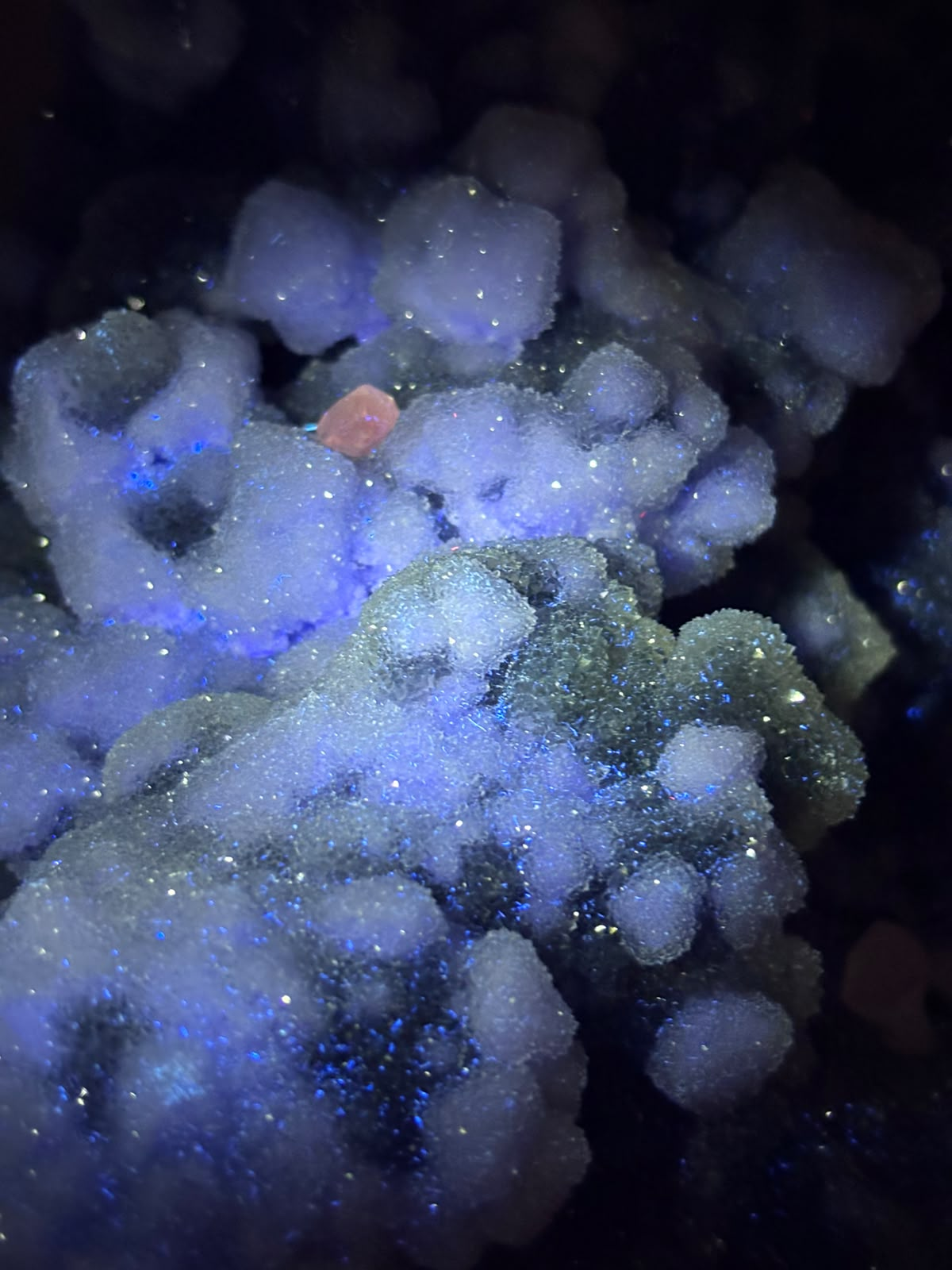
Under ultraviolet illumination, areas of the specimen display blue-violet fluorescence, revealing a different aspect of its mineral composition. The response is shown in the accompanying photograph.
Presented on a metal specimen mount with a clear display base, this is a substantial collector's piece with genuine presence. At 4.46 kg, it deserves somewhere it can be examined and appreciated rather than simply tucked onto a shelf.
Mineralogy & Formation
Chalcedony is a microcrystalline form of silica, primarily composed of quartz and sometimes moganite. It can develop in a variety of habits, including rounded and botryoidal formations, depending on the conditions under which silica-rich fluids deposit material.
Fluorite is a calcium fluoride mineral recognised for its wide range of colours, distinctive cubic crystal structure and frequent association with other minerals in hydrothermal deposits.
Calcite is calcium carbonate and occurs in an exceptionally broad range of crystal habits. It is also known for fluorescence in some specimens, although the response depends on the material's composition and trace impurities.
The combination of chalcedony, fluorite and calcite creates a mineral association of considerable visual and geological interest.
Locality: Xianghualing, Hunan, China
The Xianghualing mining district lies within Linwu County, Chenzhou, Hunan Province, China.
The area is recognised by mineral collectors for its diverse mineral occurrences, particularly fluorite and other minerals associated with its complex geological environment.
For a collector specimen, locality is an important part of its identity. This piece is attributed to the Xianghualing Mine area rather than a specific mine working, so we have retained that distinction rather than claiming a more precise provenance.
Traditional Associations
Within crystal and spiritual practice, chalcedony is traditionally associated with calm and communication, fluorite with focus and clarity, and calcite with cleansing and energetic movement.
These are traditional metaphysical associations rather than scientifically established properties.
Specimen Details
- Primary material: Chalcedony (black and green)
- Associated minerals: Fluorite and Calcite
- Form: Natural mineral specimen
- Locality: Xianghualing Mine area, Linwu County, Chenzhou, Hunan Province
- Country of origin: China
- Weight: 4.46 kg
- Features: Botryoidal and branching formations, fine crystalline surface and UV-reactive areas
- Display: Metal specimen mount with clear base, as photographed
This is an individual natural mineral specimen. Its complex formations, crystal growth, cavities and natural surface features are part of the piece itself.